The background buzz had been increasing for months with articles in the papers and excited chatter among family and friends, but now the impending reality stood before me. The behemoth then-named brontosaurus rose up above me next to stegosaurus, and t-rex was still under construction in the nearby hanger. My fifth grade class was on a field trip to a fiberglass artisan’s workshop near Hudson, N.Y. where they were constructing full-sized dinosaurs for the
Sinclair Petroleum exhibit at the New York World’s Fair which would be opening in a few short months.
We had all heard tales of the 1939 World’s Fair from our aunts and uncles, those hopes and dreams running into the harsh realities of the Second World War. The Cold War, the Korean War, the Cuban Missile Crisis, and the Assassination of the President had followed, but now the Space Race and new electronic technologies were inspiring the global civilization, and the upcoming fair was due to showcase the changing world. Better Living Through Chemistry! Our Friend the Atom! Bringing Good Things to Light!
My class roamed among the life-sized saurians, touching their flanks and examining the exposed frameworks over which layers of fiberglass were laminated. Scattered boulders of volcanic pumice accented the statues while they waited transport to Flushing Meadows, and my teacher chastised me for chipping off a lava fragment as a souvenir. I may still have that bubbled lump in a box somewhere.
Then, to international fanfare, the 1964 World’s Fair opened, with the stainless-steel Unisphere the focal point about which a jetpack-wearing daredevil flew orbits! Every Sunday the New York Daily News color magazine section would print gorgeous full-page pictures that highlighted an exhibit, glowing colors splashing the sides of pavilions or illuminating the Fair’s many fountains. My brothers and I eagerly anticipated our families and our classes traveling to behold these wonders with our own eyes.
Finally the day came, and the parking lot looked like the rows of cars lined up at a drive-in theater, only bigger. The globe of the Unisphere gleamed in the sun and colorful flags fluttered in the breeze. The buildings were something out of science fiction, truly “The World of Tomorrow!” They lined great fountains into which visitors flung coins for luck and were composed of domes, planes, rotundas and turrets. The scents of exotic foods wafted on the breeze, and an international chatter of voices delighted the ear. America was the crossroads of the planet! Heroic sculptures depicted men flinging stars across the sky, and full-size replicas of spacecraft stood erect around rippling, glassy buildings.

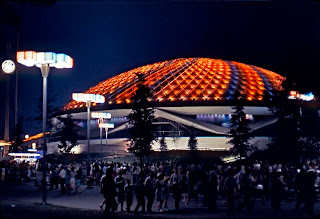
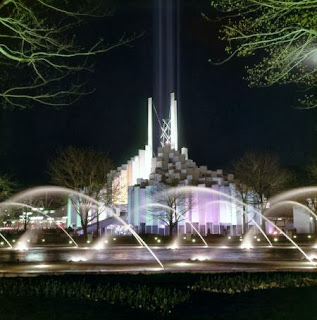
I clicked away with my Kodak Brownie 127 camera which I had received for my First Holy Communion, winding on fresh rolls of film and dropping the exposed film into pre-paid mailers for development and printing. The resolution might not have been great, but the images would resurrect memories for decades to come. Then came nightfall, and alas that the price of color film was prohibitive! Fortunately bright postcards and Ektachrome slides were available by the rack full, because the Fair was transformed into a fairyland of colored lights and beams streaming up into the sky! The GE dome was an expanse of swirling colors and the panels of the Tower of Light were transformed into rearing planes of glowing crystals. Buck Rogers, Flash Gordon, and Commander Cody could not hold a candle to this exhibition, and I have only described the architecture! Let us discuss the wonders of science!
Drop a dime in the slot and out popped a neutron-irradiated coin to insert into a souvenir holder and carry in your pocket when you visited the Atomic Energy Commission! Nuclear power would be “Too Cheap to Meter!” Walk through jungle and mountaintop and desert environments and smell the indigenous odors sprayed into the air at the Coca-Cola exhibit! Walk through a sound-deadening corridor that made your ears pop in the Bell Telephone pavilion on your way to the videophone which would periodically take a call from Walt Disney across the continent in Anaheim, California! Watch lab-coated jugglers in the DuPont exhibit pull long polymer strands of nylon out of beakers, or combine flasks of colorless fluid that suddenly glowed yellow-green like the tail of a firefly! Miracles and Wonder! Period-piece android families complete with tail-wagging dogs told the tale of advancing home-convenience items as the audience rotated around GE’s Carousel of Progress. Cities of the future, undersea and on the moon, were practically close enough to touch in the GM and Ford exhibits, and their prototype automobiles looked like they could take off and fly, as one of them would periodically drive out into a lake before returning to dry land.
The news entertained us with stories of runaways who slept in the Coke pavilion, fishing the coins out of fountains on which to sustain themselves with hotdogs, hamburgers, Belgian waffles, and cola. The free economy was transforming the world!
No one was talking about Vietnam. Not loudly, yet.
We knew that this marvelous world was coming to pass; my father brought home portable cassette recorders for his sons, then a color television. Party-line telephones were vanishing, and the newspapers printed pictures of the new, smaller computers that were only the size of bank desks! Cars were available in multiple hues, the roar of jet airliners thundered in the sky, and Polaroid cameras produced pictures virtually instantly – just don’t forget to apply the fixer! The Soviets and Americans competed to send men into orbit with eyes set on the Moon, and there was anticipation of satellites replacing the trans-Atlantic cable to carry conversations across the Big Puddle. In South Africa Dr. Christian Barnard transplanted a heart into an ailing patient. Oh, brave new world! Bi-planes would annually fly over our neighborhood, spraying DDT to eradicate those annoying mosquitos, and we waved to the pilots as the dust settles around us. Toy stores carried walkie-talkies, no longer the province of the military; and the robotic Great Garloo did your cable-controlled bidding. Colorful bug-like transistors were quickly replacing the tubes glowing within the radios, TVs, and “Hi-Fi” record players. AM radios could now be carried in your palm. Did anyone doubt that we teetered on the edge of Utopia?
How did we arrive at this pinnacle? The General Electric audio-animatronics told us about the last century, and Bell Telephones and International Business Machines displayed the evolution of electronic and calculating devices. Westinghouse encouraged visitors to inscribe their names in a register to be included in a time capsule that would be buried next to a similar container from 1939 to present the 20th Century to the world of the year 6939. The Traveler’s Insurance exhibit presented dioramas of
“The Triumph of (White) Man,” from cave dwellers to the walls of Ur, the Roman Empire( subtly promoted Christianism), and the Renaissance thinkers observing and calculating the celestial realm. You could purchase the stirring soundtrack on a red vinyl 45 rpm record to remind yourself that you were a jewel on the crown of creation.
In two years the festivities concluded and visitors packed away their assorted souvenirs and pamphlets which that they might view with nostalgia in later years. Most of the exhibits were razed and Flushing Meadows was planted as a park, the Unisphere still gracing the center, a few sturdier constructions left to perhaps be utilized at some future date.
The Future did not come as advertised although the marvelous technology highlighted at the World’s Fair was, in retrospect, quaint, far outstripped by its future’s reality. As communication and transportation brought nations closer together, it brought them into fricative conflict. The marvels of chemistry and medicine have disturbed our environment and challenged our ethics. Poor policies were implemented and mistakes were made. Utopia has receded like the chimera it has always been. But the experience of walking the lanes and corridors of the World of the Future for these brief two years in the middle 60’s still gleams like a bright dream. We can erect tower in short years and send robots to the Outer Planets. We can do whatever we set our minds to do.
But grownups need to be mindful that the choices we make can turn our dreams into nightmares.


